
Cold Storage Roofing in Hillsboro, OR
Cold storage roofing in Hillsboro, OR requires vapor, drain, and penetration checks. We inspect the assembly and plan repairs around facility operations.
Cold Storage Roofing
A cold room changes the conditions on both sides of the roof. Warm, moist air can move toward a colder layer, while penetrations and roof-to-wall transitions can create paths for condensation or leaks. In Hillsboro, OR, I inspect the membrane, insulation, vapor-control details, drains, and equipment curbs before proposing a repair. The Hillsboro normals show about 64 daily minimums at or below freezing each year. On a cold-storage roof, we check drain bowls, exposed flashing, and equipment supports before choosing a weather window. For a cold-storage roof, that temperature record makes the drain bowl, exposed flashing, and cold-weather installation window worth checking. Orenco Station is a mixed-use area with shops and services close to a transit stop. That district pattern differs from a refrigerated operation, where the facility contact confirms roof access and occupied entries. We tie each recommendation to the roof layers and the facility’s operating rules.
Cold-storage conditions make the vapor-control design worth checking against the roof layers. We review available records, identify the deck and insulation, and examine seams, penetrations, and repaired areas where moisture may be present. A commercial roof inspection gives the owner a marked baseline before a patch, recover, or replacement is priced. The report separates observed conditions from questions that need a test opening.
Related Roofing Pages
More pages on commercial roofing in Hillsboro:
Trace moisture through the roof layers
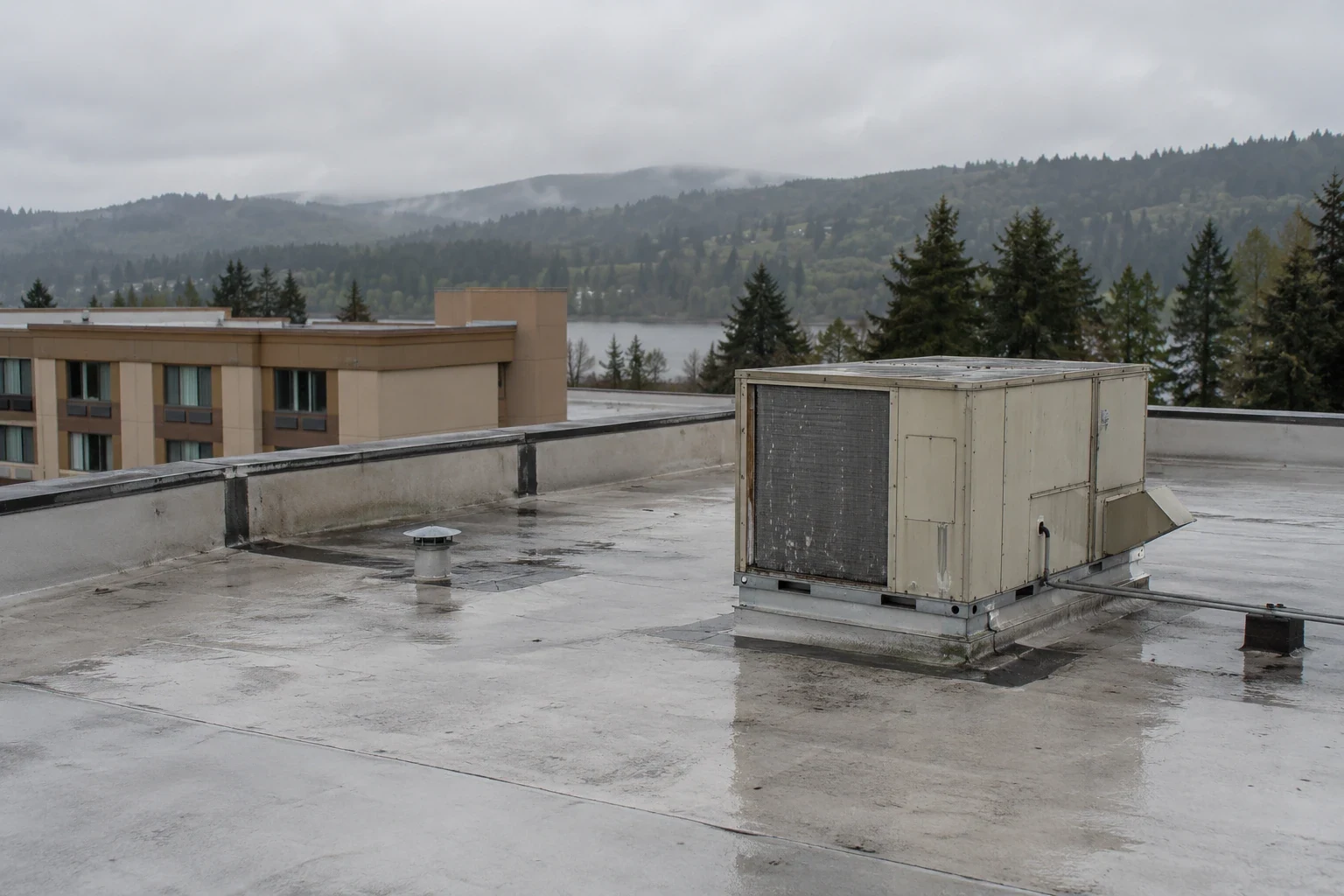
We begin around refrigeration lines, exhausts, electrical penetrations, and curbs where the membrane meets equipment. The flashing needs to remain continuous as the roof and mechanical system move through temperature changes. We check the lap, corners, sealant, and termination, then inspect adjacent insulation for softness or displaced material. The location of moisture helps define whether the work belongs at one detail or across a wider area.
Hillsboro’s normal wet season extends from October into January. Rain can expose a loose termination, and freezing conditions can leave drains or exposed water paths vulnerable. We check strainers, bowls, overflows, and slope transitions for obstruction or ponding. Transit-rich Tanasbourne and AmberGlen form a regional center for western Washington County employment and housing. For a concealed moisture question, an infrared moisture survey can be added when roof conditions support the method. That broader employment and housing area gives a local reference for occupied commercial property, but the roof walk still follows the particular facility’s hatch, service lanes, and safety boundaries. We mark routes around refrigeration equipment and identify spaces where a lift, hose, or material pallet cannot obstruct service access.
Separate condensation from a roof leak
Condensation and rain entry can produce similar interior evidence. We compare weather timing, equipment cycles, insulation conditions, and roof details to trace the water path. A failed curb flashing may admit water at one point; an interrupted vapor-control layer can affect a broader cold-side area. The scope identifies which condition the inspection confirmed and what inspection step is needed before materials are removed.
When the membrane and insulation remain sound, a compatible patch or flashing repair may be enough. If wet insulation extends beyond the penetration, we open the affected area, remove compromised material, and restore the layers to a firm boundary. Flashing repair addresses the transition; ponding-water correction belongs in a separate scope if drainage is also failing.
System choice depends on deck, attachment, vapor control, service temperature, and the existing membrane. A manufacturing-plant roof may also require attention around process equipment, while a distribution center roof often has long fields and loading access. We inspect records and field conditions before pricing a PVC membrane, TPO, or another compatible assembly.
Protect temperature-sensitive operations
Before work begins, the building contact identifies areas where roof access, vibration, dust, or a temporary shutdown could affect operations. We record refrigeration equipment clearances, lines that cannot be disturbed, the loading route, and the approved staging zone. If the roof opening is above a sensitive space, the plan notes protection below and a daily closeout point for the temporary tie-in.
We keep the open area within the weather window and restore the membrane before leaving the section. If removal reveals saturated insulation or an unexpected deck, we document the added condition and obtain direction before expanding the work. The owner can then compare the confirmed repair with a larger replacement phase. Occupied-building reroofing uses a sequence coordinated with access, notifications, and the operating schedule.
Longer work may be divided by roof zone so that equipment service and material delivery remain predictable. We mark each completed section and note any area held for further testing. If adjacent systems require a mechanical contractor, we coordinate the roof opening and flashing reset with that trade rather than leave the detail unfinished. Insulation and cover-board work is scoped with the vapor and edge transitions it changes.
Price moisture removal and detail work separately
Cost depends on how far moisture has traveled, how many curbs or line penetrations require rebuilding, and whether the deck needs repair. A dry flashing adjustment is not the same scope as removing wet insulation and restoring vapor-control layers. We mark measured boundaries, identify material transitions, and list any test opening still needed to confirm hidden conditions. Separate line items help the owner see what is established and what may change.
Cold-weather work requires attention to surface moisture, temperature, and product installation limits. Hillsboro gets about 35.93 inches of precipitation a year, and October through January is the wettest stretch. We check current conditions before preparing the substrate and close each area against forecast exposure. If rain or freezing temperatures interrupt the plan, we protect the roof and set the next workable window.
A scheduled maintenance inspection checks drains, seams, curb flashings, and prior repairs before a small defect reaches insulation. It also records equipment changes that create new penetrations. Maintenance does not correct a failed vapor layer or replace wet material. When an active opening needs attention, call at any hour for emergency roof repair. Interim protection and permanent work are scoped separately against safe access and the identified assembly.
Questions About Cold Storage Roofing
How can you tell if moisture is condensation or rain entry?
We compare the timing of the moisture with weather, equipment cycles, insulation readings, and the condition of roof penetrations. A local flashing failure and a broader vapor-control issue need different repairs. The report records what the inspection confirms and whether a selective opening is needed to identify the point of entry.
Can roofing work happen while refrigeration stays on?
We plan around equipment clearances and operating rules, then isolate the roof area where practical. Some details can be repaired without a shutdown, while work near a line or sensitive space may need a coordinated window. The facility contact approves any interruption before the crew begins that part of the scope.
What happens if insulation under a cold-storage roof is wet?
We map the affected material, open the assembly where needed, and remove insulation that has lost its dry, stable condition. The restoration must reconnect the insulation and vapor-control details with the membrane. The measured area is priced separately from dry sections so the owner can review the repair boundary.
Why check drains on a cold-storage building?
Water can collect at a low point and stress nearby seams or flashing. We inspect the drain bowl, strainer, overflow path, and membrane around the opening, with current temperatures and surface conditions in mind. If a slope or outlet issue remains, the scope identifies that correction apart from the membrane repair.
Can a new roof be installed over the existing cold-storage assembly?
A recover is considered only after the deck, insulation, vapor-control layers, attachment, and added height are reviewed. Wet material or an unresolved condensation path should be addressed first. We compare recover and tear-off options with the actual assembly and the required work window.
Set a cold-storage roof inspection
Tell us where moisture appears and which equipment must remain available. We will inspect the roof layers, map penetrations and drains, and price the repair boundary or replacement phase.